
Somatic Therapy
When Talk Isn’t Enough
Some people have gained plenty of insight about their issues through talk therapy, but they don’t feel any better. If anything, retelling their stories of pain and trauma concretizes their negative narratives about themselves.
Somatic therapy takes into account your nervous system and body, which holds all of your experiences, and movement takes it one step further. Our nervous systems extend throughout the body, so when you move the body, it changes the mind. Rather than sitting and having a conversation which keeps the issues up in your head and doesn’t solve the pain in your heart, a bottom-up, embodied approach can help you get unstuck. Imaging studies even show how dance integrates the mind and body and improves wellbeing.
Words do not always express how you are feeling. Using gestures or movement allows you to bypass this barrier. Even without moving, body language does not lie. Since the mind and the body are closely connected, a somatic approach can be especially helpful for people with chronic pain or illness. It can also benefit people simply seeking personal growth.
It’s common when one is feeling bad to take a walk and then feel a bit better or have a better perspective. By the same token, moving in therapy offers this benefit but with the chance to reflect immediately. It can also be fun and gives you an inroad to joy.

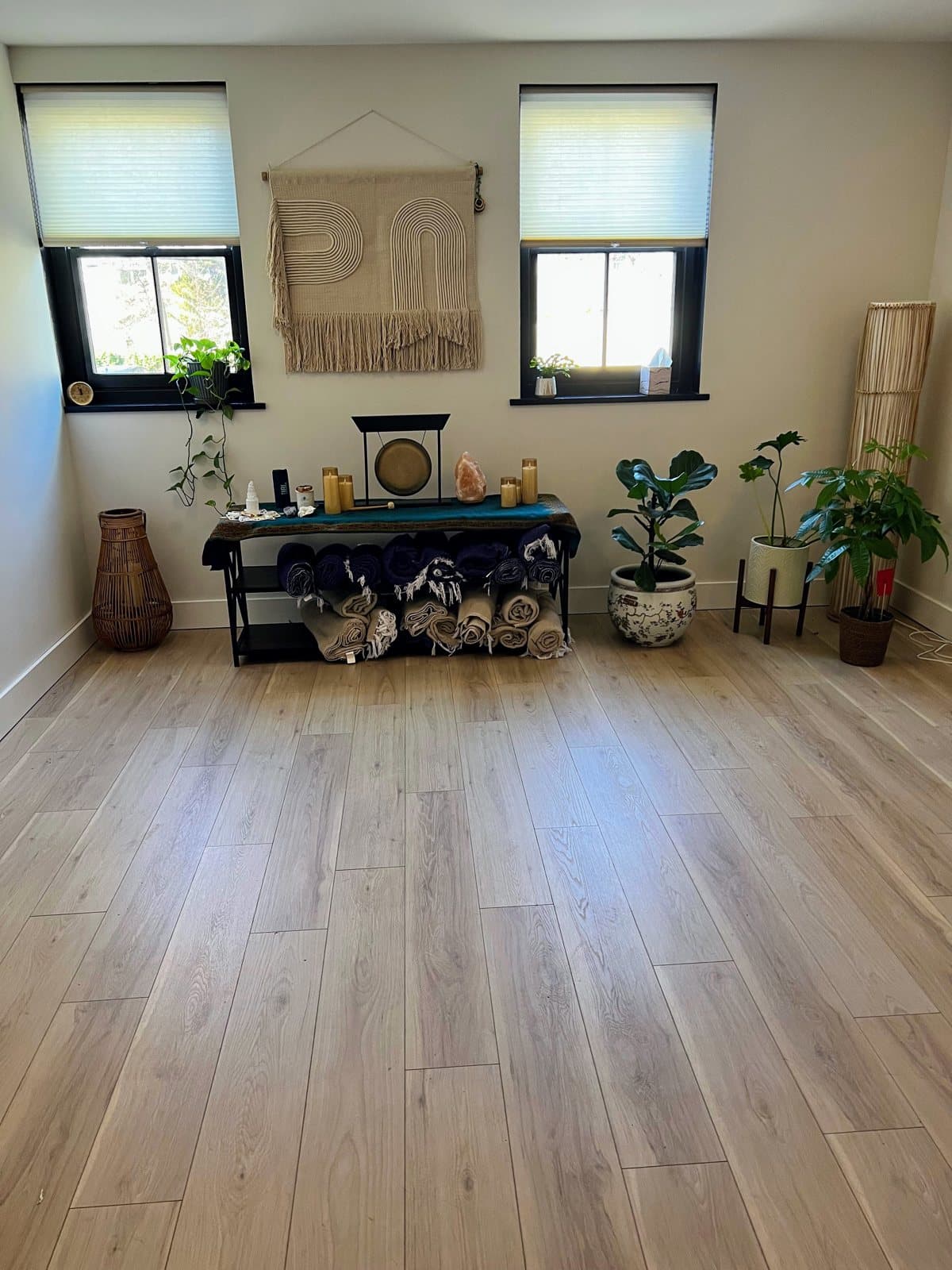
My office has space to move or lie down, allowing you to be more in touch with your body.

Somatic Experiencing (SE)
Our feelings are held in our bodies. For that reason, talking about our problems and gaining insight often is not sufficient for significant improvement. Somatic Experiencing is a method developed by Peter Levine which focuses on the nervous system and is particularly helpful for trauma, shock, and stress, which disrupt the nervous system.
This method addresses the fight, flight, and freeze responses that manifest after trauma. It is not necessary to reexperience the trauma to allow the body to process it. SE takes a gradual approach that builds safety and stability using titration, which allows you to bite off only as much as you can chew at one time. You can determine the pace of the process.
By tuning into what you notice in your body, whether sensations, images, actions, feelings, or thoughts, SE helps you increase your physical awareness. This can also mean paying attention to your breath and posture, while slowing down and focusing on the present moment. This increased attunement allows greater engagement with other people and the world.
Through what is called “pendulation,” you are guided to find resources that support you and shift, making it possible to work with sensations and responses that have felt stuck, and then integrate the feeling. Moving between moments of relative ease and moments of discomfort allow the energy to move and helps you come from a healthier, more grounded and resilient place.
I completed a 3 year training to become a Somatic Experiencing Practitioner, taking time to thoroughly learn tools to approach trauma in a gentle but healing way, allowing you to regulate your nervous system.
Dance/Movement Therapy
You don’t have to be a dancer — or even feel like moving — to benefit from this work. As a Registered Dance/Movement Therapist (R-DMT), I may gently weave movement into our sessions when it feels right for you: noticing your posture, a small gesture, or simply how a feeling shows up in your body. Nothing is choreographed and nothing is performed — movement is always an invitation, never a requirement, and you set the pace. Occasionally music finds its way in, too — a rhythm can make it easier to drop out of your head and into what you’re feeling. Because the body holds our experiences, even the smallest shift can reach feelings that talking alone sometimes can’t.
Common Questions About Somatic Therapy
- Do I have to move or dance?
No. Movement is always an invitation, never a requirement — for some people it’s as small as noticing a gesture or how they’re sitting, and plenty of the work happens sitting and talking. You set what feels right, and we can keep it as subtle as you like.
- What if I’m not very in touch with my body?
That’s common, and it’s often exactly where the work begins — many of us learned to live up in our heads. You don’t need any special body awareness to start. Part of what somatic therapy offers is gradually feeling more at home in your body: more present, and more alive in your own experience. For a lot of people that reconnection becomes one of the most rewarding parts.
Wondering what the first session is like? See how getting started works.
Further reading — the New York Times on the neuroscience of dance and wellbeing.
I’m a masters-level Registered Dance/Movement Therapist (R-DMT), credentialed through the American Dance Therapy Association.
Ready to take the first step?
Book a free 15–20 minute consultation to see if we’re a good fit, or send a message below with any questions.